9 Questions to Ask Before Hiring a Seattle Production Company
Hiring a video production company is a risk decision, not just a creative one. A polished reel tells you almost nothing about what happens between signing and delivery.
This guide is written for marketing managers, communications directors, nonprofit leaders, and event organizers evaluating Seattle production companies for a real project. It gives you 9 questions to ask in your first meeting or during proposal review, and a framework for reading the answers.
The short answer: the best partner is the one whose business model matches your scope, whose recent work resembles your use case, and who answers the uncomfortable questions without hedging. The 9 questions below are designed to surface all three.
The 9 Questions to Ask Before Hiring a Seattle Video Production Company
1. Can you show me three pieces of recent work for an audience and distribution channel like ours? Not a general portfolio. Not their best reel. Work that matches your specific use case — a donor-facing nonprofit film, a multi-camera conference recording, an internal communications video. If a company can't point to relevant recent examples, they're asking you to be a test case.
2. Who is my primary producer, and will they be on set? Some companies pitch senior talent and deliver junior crews. The producer who runs your discovery call should be the same person managing your shoot. The answer tells you whether you're buying a relationship or just a deliverable.
3. How do you handle scope changes mid-project? Every project changes. The question is whether the company has a clear, written process or handles it case by case. Vague answers here mean surprise invoices later.
4. What's included in your revision process, and what triggers an additional charge? Most companies include two to three rounds of revisions in base scope. Understand what counts as a revision, what happens if stakeholders disagree internally, and when additional edits become billable. This conversation is much easier before you sign than after.
5. What does a realistic budget look like for this project — and what's the cheapest corner someone could cut to underbid you? The second half is the more revealing one. A company that can articulate what gets cut at lower price points understands the craft. If they can't explain it, they may not know what they're actually delivering.
6. How do you plan for content reuse across formats and channels? A two-minute brand film can also yield a 30-second social cut, a 90-second donor version, and three testimonial clips. A partner who thinks about this during pre-production saves you time and money. If the question draws a blank, you're working with a team optimized for single deliverables.
7. Who runs audio on your live events, and what's your backup plan if a mic fails? For any project involving live or hybrid coverage, this question separates serious production teams from reel-only shops. Professional crews carry backup wireless systems and have clear protocols for technical failures. Vague or defensive answers are a signal to keep looking.
8. What does your pre-production process look like for our venue or event type? A strong team will ask about in-house AV, load-in restrictions, run-of-show timing, and stakeholder approval before a camera is ever unboxed. A team that skips this is planning to improvise on your dime.
9. Tell me about a recent project that went sideways. Teams with nothing to say here have either never had a crisis or don't want you to know how they handled it. The teams worth hiring have honest answers: a camera failed mid-panel, a speaker cancelled an hour before, a venue's AV system was incompatible. What matters isn't that problems happened — it's that the team solved them without the client ever knowing.
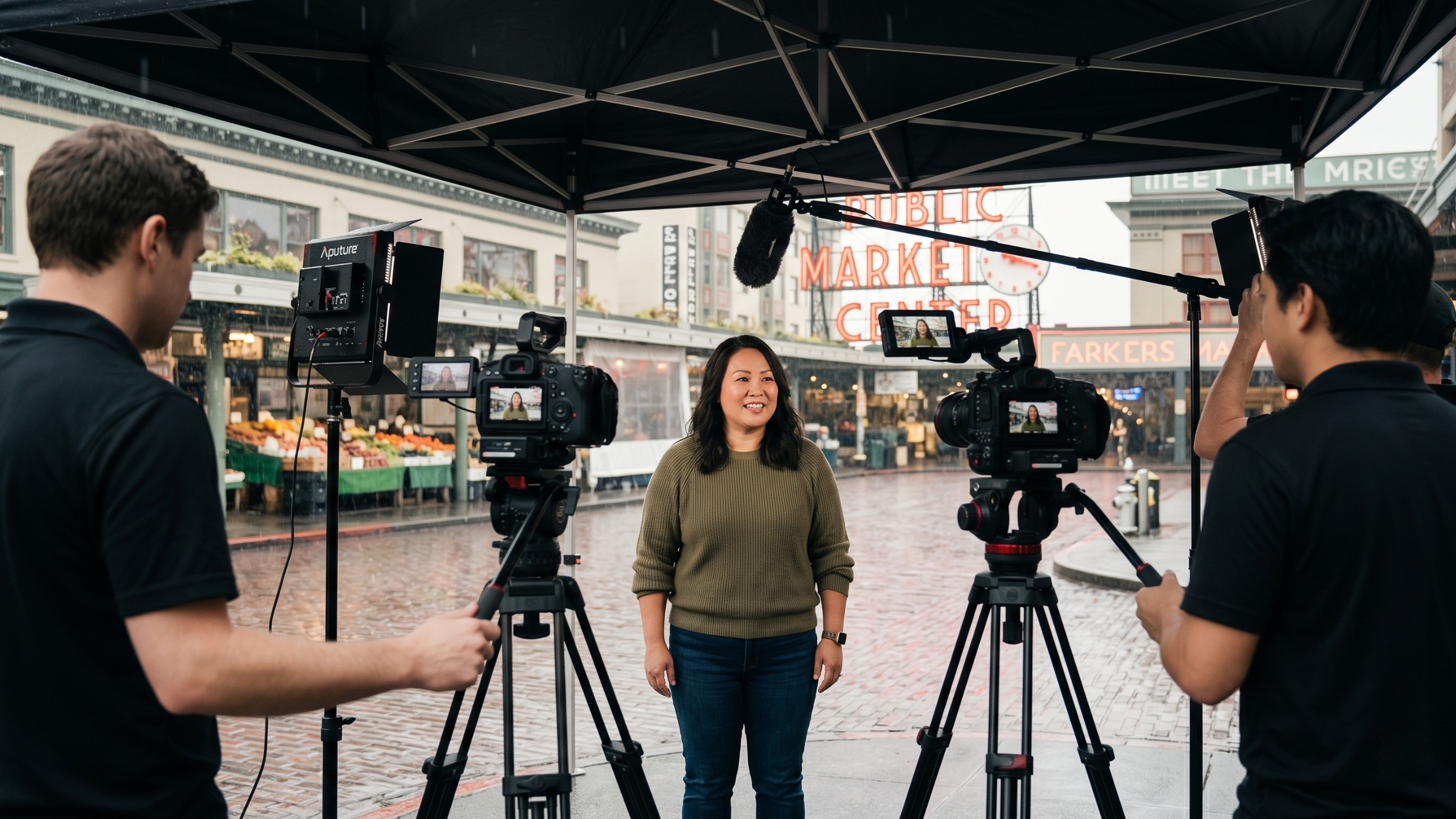
The Three Kinds of Seattle Video Production Companies
1. Boutique film specialist. Best for flagship brand stories, documentaries, mission films, and emotionally driven nonprofit campaigns. Watch out for limited event infrastructure, no AV capability, or thin bandwidth for recurring content.
2. Full-service media partner. Best for corporate communications, multi-day events, hybrid productions, and ongoing content programs that need AV, video, and consulting under one roof. Broader scope means higher investment — overkill for a single straightforward deliverable.
3. Solo videographer or execution shop. Best for simple single-camera shoots, lower-budget social content, and basic event b-roll. Limited strategic depth, minimal backup capacity, no producer layer for complex projects.
The mistake most buyers make is evaluating all three types against the same criteria. A documentary studio shouldn't be penalized for lacking a dedicated AV crew. A full-service event partner shouldn't be penalized for charging more than a solo operator. The question is always: does this company's model match what my project actually requires?
For a deeper look at how this plays out in event contexts, our event production services page covers what unified event media production actually includes.
.jpg)
How to Read a Portfolio Without Getting Distracted by the Reel
A highlight reel shows a company's best footage under the best conditions. It rarely shows whether the team solved a problem like yours, for an audience like yours, under constraints like yours.
When reviewing any production company's work, look for:
- Relevance: Work for your audience type, industry, or distribution channel.
- Recency: Projects from 2024 or later — not legacy work from 3-5+ years ago.
- Depth: Case studies that explain the brief, the constraints, and the outcome.
- Range: Multiple formats and use cases, not one style repeated across every example.
- Audio quality: Clean, consistent sound. Inconsistent audio is a major weak signal.
What Seattle Video Production Pricing Actually Depends On
A 90-second video can cost $1,500 or $25,000 depending on scope. Here's how project scope maps to investment ranges in the Seattle market.
- Single-location brand or testimonial video (1 shoot day, 1-2 interviews, basic edit): $2,500 – $7,500.
- Multi-interview corporate or nonprofit film (1-2 shoot days, multiple subjects, documentary approach): $7,500 – $18,000.
- Campaign or brand story video (scripted or documentary, multiple locations, strategic pre-production): $15,000 – $40,000+.
- Single-day event coverage (multi-camera, highlights, basic edit): $3,500 – $8,000.
- Multi-day conference with livestreaming and AV (standard scope; enterprise-scale events run higher): $12,000 – $65,000+.
How to read a proposal that seems cheaper than the range. The cheapest quote is usually the least complete quote. Common items cut at lower price points: dedicated audio engineer, backup equipment, producer-level oversight, music or graphics licensing, more than one round of revisions, and any deliverable beyond the primary cut. A $4,000 proposal that excludes audio, a second camera, and social cuts isn't cheaper than a $6,500 proposal that includes all three — it's a different product.
The right question isn't "what does this cost?" It's "what's included at this price?" For help building a video budget before going out to bid, our media consulting services include scope planning and vendor evaluation support.
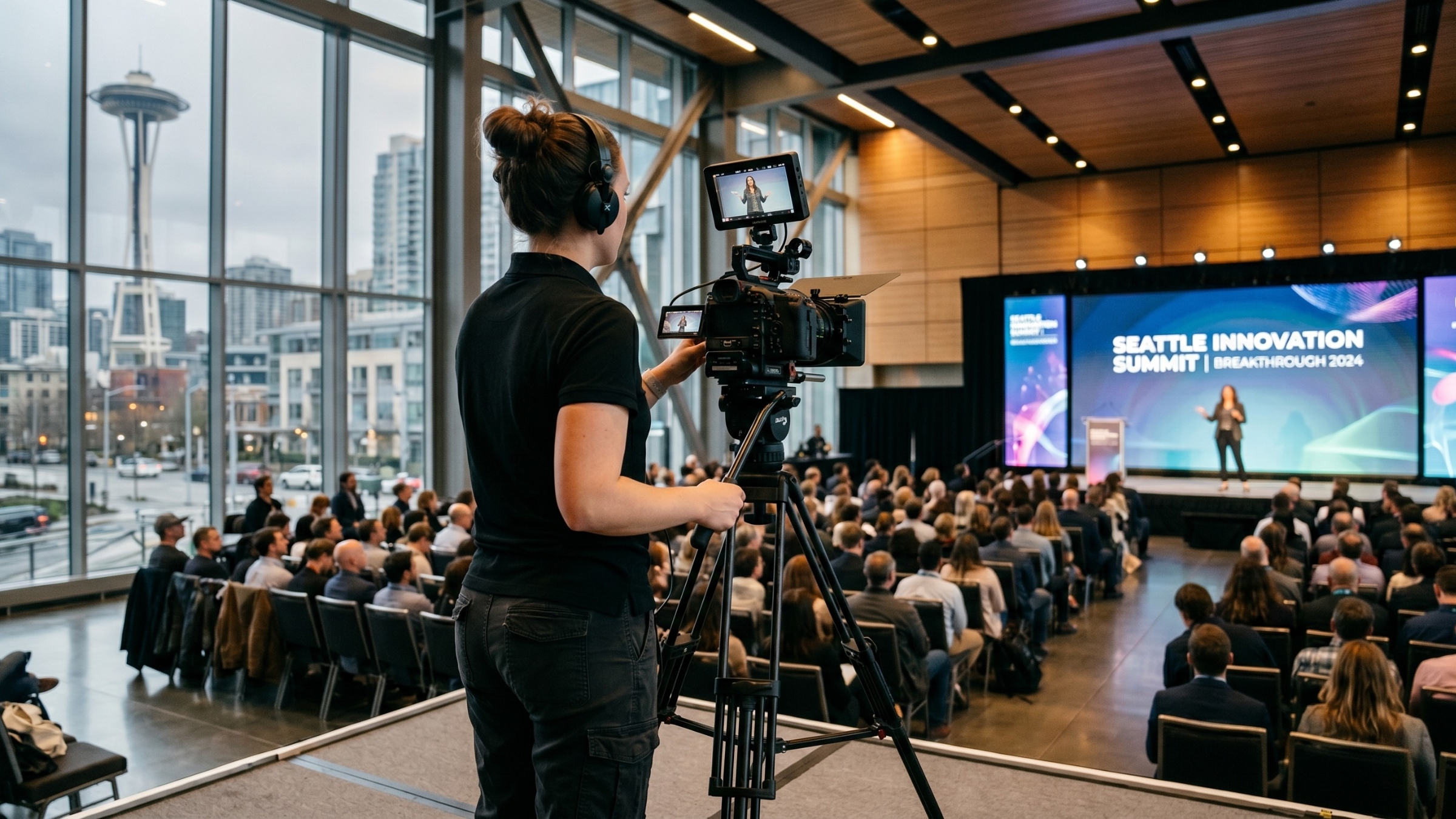
Seattle Realities That Out-of-Town Guides Miss
Seattle has specific production and event logistics that affect how projects get planned and executed. A partner with local experience navigates these without being told.
- Venue AV politics. Many Seattle venues have in-house AV teams with contractual requirements or exclusivity clauses. An experienced local partner knows which venues require house audio and how to negotiate the handoff.
- WSCC and major venue load-in rules. The Washington State Convention Center and similar venues have specific load-in windows, freight elevator schedules, and union labor considerations. A partner who has worked these venues before plans for these constraints.
- Pacific Northwest weather. Outdoor production needs backup plans for rain, wind, and flat overcast light. Local crews build this in. Out-of-town crews often don't.
- Parking and load-in in dense neighborhoods. Capitol Hill, South Lake Union, Pioneer Square, and Belltown all have different logistical profiles for production vehicles and equipment staging.
Local knowledge isn't a soft differentiator. In event and location production, it's a risk management asset.
How to Know You've Found the Right Partner
The right partner makes you feel like the project is in good hands before a single camera is unpacked. Concretely:
- They ask about your audience, stakeholders, and distribution plan before talking about gear.
- They explain their process clearly, including what happens when something changes.
- They answer the uncomfortable questions without hedging.
- They've done work that's genuinely relevant to your use case, not just adjacent to it.
- They give you a realistic budget conversation, not just a number.
The best production partner isn't the cheapest quote or the biggest one. It's the one whose scope clearly matches your goals, audience, timeline, and distribution plan. The 9 questions are how you find them.
If you're planning a multi-day event with livestream components, managing a recurring content program, or producing a brand film that needs to live as social content and event loops, our video production services and event production services cover the full scope. Or if you're ready to talk specifics, request a custom quote — bring the 9 questions, we'll have answers.